
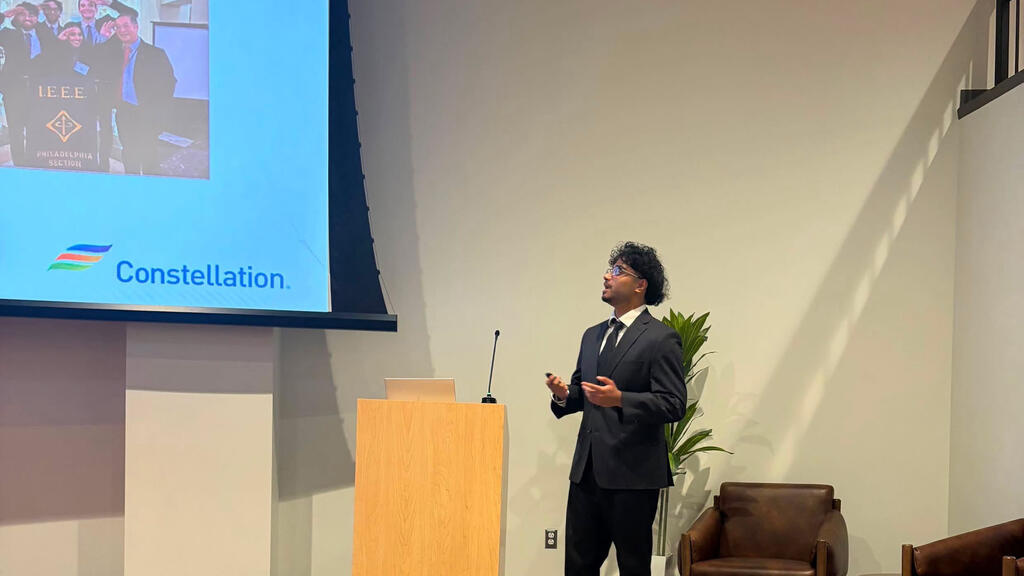
Photo courtesy of Sahil Singh
Leveraging technical skills gained from hands-on classwork and leadership experience from the student organization IEEE, senior electrical and computer engineering student Sahil Singh landed his first internship this summer at Constellation Energy.
He received an extension to continue his work with Constellation part-time through the fall semester, leading him towards his goal of a career in power systems.
Singh spoke with the College of Engineering to share his internship experiences as well as the coursework he thinks prepared him most.
College of Engineering: What organization are you interning for this summer and what is your role?
Sahil Singh: I'm interning at Constellation Energy, the largest producer of clean energy in the country and operator of one of the biggest nuclear fleets in the U.S. I'm on the Power Uprate team within Power Operations, based out of Kennett Square, PA.
College of Engineering: What does your average workday look like?
Singh: Most of my day is spent working through technical documentation for our active power uprate projects, which is the process of safely increasing how much electricity a nuclear plant can generate. I support Measurement Uncertainty Recapture (MUR) uprate efforts for multiple sites by reviewing TODI (Transmittal of Design Information) packages—the official records of design changes across the plant. I also work through ComEd Grid Voltage Adequacy (GVA) study inputs, which check whether the surrounding grid can handle the extra output, and compare ETAP (electrical modeling software) outputs against hydraulic task report values for the condensate, condensate booster, and reactor feedwater pumps, cross-checking that the electrical models and real-world mechanical numbers agree. I also track UVAs (Unverified Assumptions). UVAS are placeholder values used while we wait on finalized numbers, so nothing gets built on a figure that turns out to be wrong.
I also went through dedicated generator training, focused mainly on the isophase bus duct, the isolated phase bus connecting the generator to the main power transformer. It carries very high current at relatively low voltage, with each phase enclosed to manage heating and induced currents.
College of Engineering: What do you enjoy the most about your internship?
Singh: Knowing that the work I'm doing has a real, tangible outcome. Power uprate projects let nuclear plants that are already running safely produce more electricity, so more carbon-free power gets added to the grid without building anything new. Being trusted with real, confidential project documents this early in my career, and watching a number go from a rough estimate to something the plant actually relies on, has taught me a lot about how the nuclear industry really runs day to day.
I also got to see a lot of this in person, including a tour at Limerick and a site visit to Peach Bottom, plus a crane tour. Walking through the actual plants and seeing the equipment made the systems I'd been reading and writing about for weeks feel a lot more real.
College of Engineering: What courses do you feel most prepared for your internship?
Singh: Power System Analysis was the most directly useful course I've taken, since it gave me hands-on experience building system models and analyzing voltage issues, which connects closely to the grid voltage adequacy work I've supported this summer. My Electromechanical Energy Systems course, where I studied transformers in detail, also turned out to be more relevant than I expected, since transformers came up constantly in the generator systems work I was doing. Courses that covered electromagnetics and circuits also helped me follow the technical reasoning behind uprate calculations as well.
College of Engineering: How do you think you've grown as an engineer during your internship?
Singh: I've grown the most in learning how to operate in a corporate, highly regulated, safety-critical environment, where nothing gets assumed without being clearly documented and verified. Passing my Nuclear General Employee Training on day one and then working directly with UVAs (Unverified Assumptions) on live projects taught me to think carefully about what's confirmed versus what's still pending, and how to communicate that clearly to senior engineers. I also had the opportunity to present my summer work to Constellation leadership in a three-minute executive format, which pushed me to get better at communicating technical material concisely instead of trying to cover everything I knew.
College of Engineering: What advice do you have for students trying to secure an internship or who may be starting an internship for the first time?
Singh: Get involved outside the classroom early, and stick with it. I started out just getting involved with IEEE, worked my way up to Vice President of Temple's IEEE Student Branch, and eventually founded Temple's own IEEE Power & Energy Society chapter, building up the support and interest needed to actually get it off the ground. That whole progression, along with serving as an NSF STEPS Ambassador, gave me real conversations to bring into interviews and helped me understand the industry before I ever held an internship title. I was also a Research Assistant, and I applied to a lot of jobs and internships before landing this one, so I know firsthand how much time and effort the search can take. It's worth sticking with it, because it does pay off.
Once you're actually in the role, don't be afraid to ask questions, and don't underestimate the value of the people around you. The connections I made this summer, from other interns to senior engineers who were willing to explain something twice if I didn't get it the first time, ended up being just as valuable as the technical work itself.