
Photo by Casey Tinney
With some preliminary research experience under his belt, junior bioengineering student Shirshya Dhar is expanding his engineering and professional skillset as an undergraduate researcher in Professor Anita Singh’s Neural Injury Biomechanics Laboratory. Dhar spoke with the College of Engineering to share how his summer research experience has affirmed his career goals while simultaneously exposing him to more possibilities within the bioengineering field as well as sharing advice for other engineering students.
College of Engineering: What is the research of the Neural Injury Biomechanics Laboratory?
Shirshya Dhar: Dr. Singh’s research focuses on understanding how neonatal brachial plexus injuries occur and how they can be prevented during a birthing complication known as shoulder dystocia, where the baby's head emerges but the shoulder becomes lodged behind the mother's pelvis. The brachial plexus is the network of nerves that run from the spinal cord in the neck, through the cervicoaxillary canal, over the first rib, and into the armpit, supplying the chest, shoulder, arm, forearm, and hand.
College of Engineering: What drew you to work on research in this lab?
Dhar: I was initially working on adjacent projects through Dr. Andrew Spence's lab and the prosthetics club. When I received an email from Mike Madera, director of career and professional development at the college, about the summer position being available, I looked into Dr. Singh's lab and knew I had to apply after reading about the kind of work they were doing.
College of Engineering: What does your average day in the lab look like?
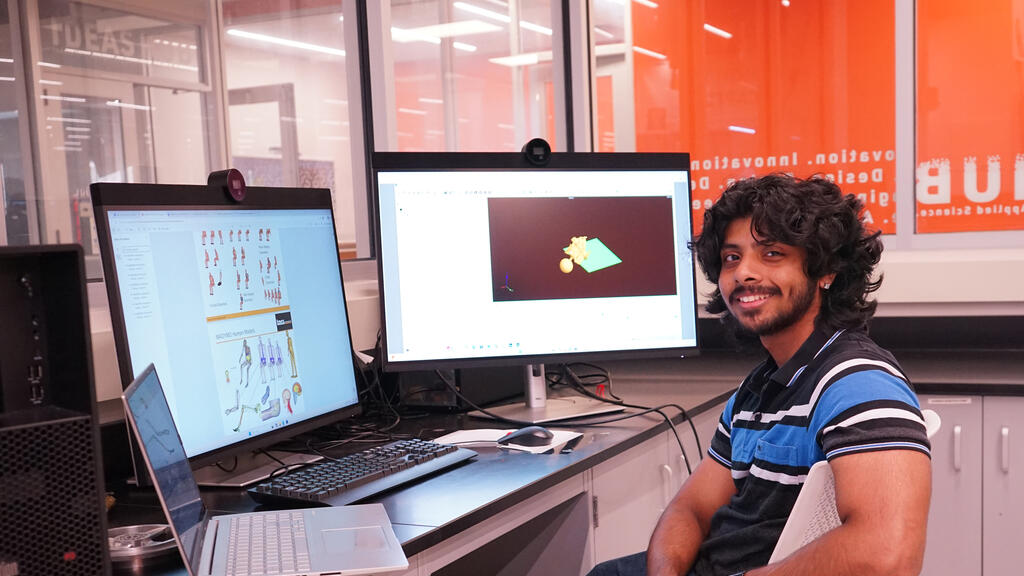
Dhar: I work remotely, since all my work runs on a remote desktop. I usually log in shortly after finishing my shift at the College of Engineering Office of Enrollment Management My main task is running simulations in MADYMO (Mathematic Dynamic Models), testing different procedural conditions and material properties for the nerve. I then compile the resulting data and simulation videos for Dr. Singh to evaluate. I also occasionally translate older models to the current version of MADYMO.
College of Engineering: What do you enjoy most about being a student researcher?
Dhar: What I enjoy most is knowing that the work I'm contributing to today could help improve someone's life in the future, whether directly or indirectly. There's a real sense of pride in that.
College of Engineering: What advice do you have for students considering research?
Dhar: My first piece of advice is to read up on what's happening on campus around you. At Temple, we're fortunate to be an R1 institution, so I'd encourage students to look through the profiles of professors in their major, see what kind of research they're conducting, and reach out directly to the ones whose work interests them.
My second piece of advice is that research demands a broad skill set, even within a highly specific or niche field. You'll start with certain foundational skills, but you'll need to pick up a lot more along the way, on the job.
College of Engineering: How has this experience shaped your future professional goals?
Dhar: My end goal is to work toward developing technology that bridges the gap between humans and computers, particularly in neural engineering and neuro-prosthetics. I think this path really started with my work in the prosthetics club and Dr. Spence's lab, where I first got exposed to the mechanics of restoring biological function. Working in Dr. Singh's lab this summer has deepened that interest in an unexpected way. Simulating how nerves like the brachial plexus respond to physical stress has given me a much better understanding of the biomechanical side of the nervous system, which is exactly the kind of foundation you need to design interfaces that communicate directly with the body. Long-term, I'd love to work on technology like neural-controlled prosthetics or brain-computer interfaces, where understanding nerve behavior at this level is just as important as the computer science side.